The Museum highly values collaborative research and in recent years has worked on projects with Stanford University Hospital, UCLA, NASA Ames Biocomputation Center, and the British Museum.

Museum’s Rare Cuneiform Collection added to Digital Library

In March 2009, two UCLA staff members of the Cuneiform Digital Library Initiative (CDLI) project (Brumfield and Heinle) scanned 148 Rosicrucian Egyptian Museum tablets, and processed the tablet surface images according to CDLI's "fat-cross" standards to complement the SET (Sumerian Economic Texts from the Third Ur Dynasty) publication of the Rosicrucian and other U.S. tablet collections published in 1961 by Tom B. Jones and John W. Snyder in transliteration only; collations of the Rosicrucian Egyptian Museum tablets in SET were subsequently published by M. Cooper in 1986 (ASJ 8, 309-344) and by J. Carnahan and K. Hillard in 1993 and 1994 (ASJ 15, 246-251; ASJ 16, 310).

This digital imaging was supported by a National Leadership Grant for Libraries - Building Digital Resources from the Institute of Museum and Library Services, and is part of the on-going mission of CDLI to ensure the long-term preservation of texts inscribed on endangered cuneiform tablets, and to provide free global access to all available text artifact data in furtherance of cuneiform research.

Click to view the digital collection

Mummy Revealed

Two thousand years ago in the sands of Egypt, grieving parents put their tiny child to rest in a way that was customary even during the time of Christ. They removed all of the youth’s organs except for the heart, packed the remains in salt to cure them, and wrapped them in linen coated with perfumed resin. Like all Egyptians of the age, they were certain that their careful efforts would prepare their loved one to someday come back to life.

Today in Silicon Valley, a team of world-renowned experts proved those parents right – although the mummy’s high-tech resurrection may not quite be what ancient Egyptians had in mind. In early 2005, a team of researchers and computer engineers led by W. Paul Brown of Stanford University began to unravel the threads of this mystery using the latest imaging technology. Equipped with the most detailed 3D models ever created of a mummy, the team of experts showed how 60,000 exceptionally high-resolution 2D scans helped give life to the mummy without disturbing its delicate form.

Radiologists at Stanford University used a high-resolution C-arm computed tomography (CT) scanner from Siemens Medical Solutions to generate 60,000 2D scans of the unopened, intact mummy. Computers running the latest 3D computer graphics at Silicon Graphics used these scans to create a 3D model of the mummy and its interior.

Analysis of the data revealed that the 2000-year-old mummy is the remains of a 4- or 5-year-old girl from a well-to-do family. The Rosicrucian museum has since named her Sherit, ancient Egyptian for “Little One.” Her body showed no telltale signs of trauma or long-term disease, and so the researchers believe Sherit died unexpectedly.

Coffins Related?

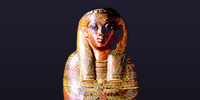
Two of our loveliest coffins, the coffins of Lady Ta'awa and the Priest Usermontu, date from the same time period, the 26th Dynasty (about 625 BC). They came to us separately, a decade apart, from different parts of the world.

Now, after partially translating the inscriptions, we believe this man and woman may have been relatives. Thanks to research in the Netherlands, we know that Ta'awa was from the Besenmut family, so named because many of the men were named Besenmut. The full title of Usermontu tells us that he is the priest Usermontu, son of Besenmut, priest of the god Montu, Lord of Thebes.

Initial research suggests that these two may have been cousins.

2009 Food Drive to support Second Harvest Food Bank of Santa Clara and San Mateo Counties

Rosicrucian Park is proud to announce our 2009 Food Drive to support Second Harvest Food Bank of Santa Clara and San Mateo Counties. Our drive will assist Second Harvest to feed those struggling to eat during these tough economic times.
Each month Second Harvest serves an average of 207,566 people, a 17% increase over last year. For many callers, this is the first time they are tapping into the Food Bank's services. Let’s do our part to make sure no child, senior or family goes hungry this holiday season. We invite you to participate in supporting our community.

 
Where?

At Rosicrucian Park, we are accepting food donations in the barrels located at the Rosicrucian Egyptian Museum located at 1664 Park Ave (cross street Naglee) and the Rosicrucian Research Library located at 1355 Randol Ave (between Park and Chapman).

Most needed foods include:

Meals in a can (Stew, Chili, and Soup)
Peanut Butter
100% Fruit Juices Canned Fruits
Canned Vegetables
Tuna/Canned Meat
Low Sugar Cereal
Cans with pop top lids

When?

Now! There is no time like the present to participate. Our barrels will be present until December 21.
 

Why?

Nothing else matters when you’re hungry. If your cupboards are full, please help others who don’t know where their next meal will come from.

In appreciation of your gift to Second Harvest Food Bank, and to introduce you to the Rosicrucian Egyptian Museum and Rosicrucian Research Library, we are offering all participants who bring in a bag of groceries a complimentary Friend of the Museum membership (Bes level). In addition to complimentary admission into the museum for a year, you will receive 20 percent off in our museum store, through 2009, just in time for holiday shopping!
 

Thank you in advance for your participation!